

Built different: The Proctimise story
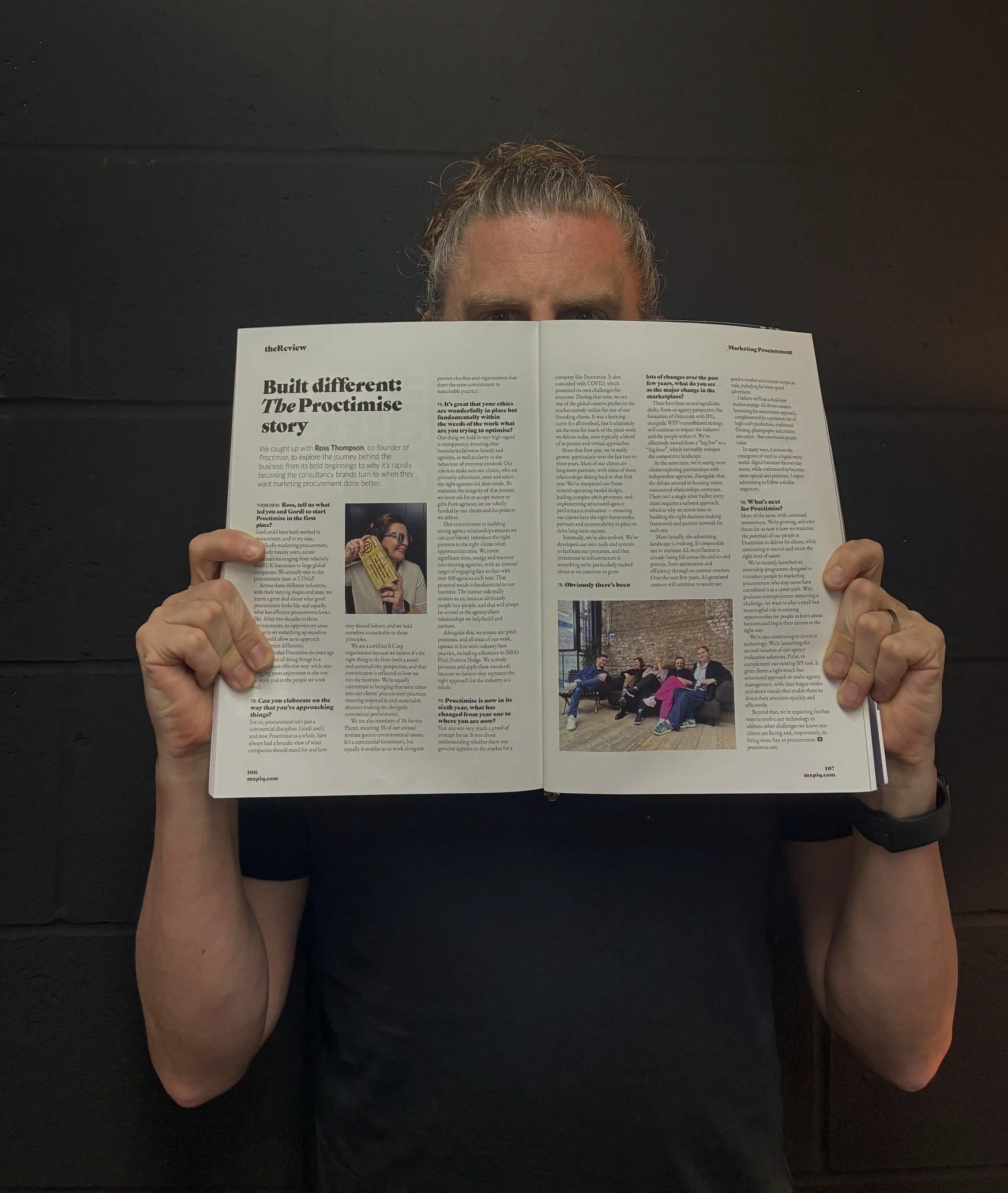
Last March, The Review caught up with Ross Thompson, co-founder of Proctimise, to explore the journey behind the business; from its bold beginnings to why it’s rapidly becoming the consultancy brands turn to when they want marketing procurement done better.
Ross, tell us what led you and Gordi to start Proctimise in the first place?
Gordi and I have both worked in procurement, and in my case, specifically marketing procurement, for nearly twenty years, across organisations ranging from relatively small UK businesses to large global companies. We actually met in the procurement team at L’Oréal!
Across those different industries, with their varying shapes and sizes, we learnt a great deal about what good procurement looks like and equally, what less effective procurement looks like. After two decades in those environments, an opportunity arose for us to set something up ourselves that would allow us to approach procurement differently.
We founded Proctimise six years ago with the aim of doing things in a simpler, more effective way, while also bringing more enjoyment to the way we work and to the people we work with.
Can you elaborate on the way that you're approaching things?
For us, procurement isn’t just a commercial discipline. Gordi and I, and now Proctimise as a whole, have always had a broader view of what companies should stand for and how they should behave, and we hold ourselves accountable to those principles.
We are a certified B Corp organisation because we believe it’s the right thing to do from both a social and sustainability perspective, and that commitment is reflected in how we run the business. We’re equally committed to bringing that same ethos into our clients’ procurement practices, ensuring responsible and sustainable decision-making sits alongside commercial performance.
We are also members of 1% for the Planet, meaning 1% of our annual revenue goes to environmental causes. It’s a commercial investment, but equally it enables us to work alongside partner charities and organisations that share the same commitment to sustainable practice.
It’s great that your ethics are wonderfully in place but fundamentally within the weeds of the work what are you trying to optimise?
One thing we hold in very high regard is transparency, ensuring clear boundaries between brands and agencies, as well as clarity in the behaviour of everyone involved. Our role is to make sure our clients, who are primarily advertisers, meet and select the right agencies for their needs. To maintain the integrity of that process, we never ask for or accept money or gifts from agencies; we are wholly funded by our clients and the projects we deliver.
Our commitment to building strong agency relationships ensures we can confidently introduce the right partners to the right clients when opportunities arise. We invest significant time, energy and resource into meeting agencies, with an internal target of engaging face-to-face with over 100 agencies each year. That personal touch is fundamental to our business. The human side really matters to us, because ultimately people buy people, and that will always be central to the agency/client relationships we help build and nurture.
Alongside this, we ensure our pitch processes. and all areas of our work, operate in line with industry best practice, including adherence to ISBA’s Pitch Positive Pledge. We actively promote and apply these standards because we believe they represent the right approach for the industry as a whole.
Proctimise is now in its sixth year, what has changed from year one to where you are now?
Year one was very much a proof of concept for us. It was about understanding whether there was genuine appetite in the market for a company like Proctimise. It also coincided with COVID, which presented its own challenges for everyone. During that time, we ran one of the global creative pitches in the market entirely online for one of our founding clients. It was a learning curve for all involved, but it ultimately set the tone for much of the pitch work we deliver today, now typically a blend of in-person and virtual approaches.
Since that first year, we’ve really grown -particularly over the last two to three years. Most of our clients are long-term partners, with some of those relationships dating back to that first year. We’ve sharpened our focus around operating model design, leading complex pitch processes, and implementing structured agency performance evaluation — ensuring our clients have the right frameworks, partners and accountability in place to drive long-term success.
Internally, we’ve also evolved. We’ve developed our own tools and systems to facilitate our processes, and that investment in infrastructure is something we’re particularly excited about as we continue to grow.
Obviously there's been lots of changes over the past few years, what do you see as the major change in the marketplace?
There have been several significant shifts. From an agency perspective, the formation of Omnicom with IPG, alongside WPP’s consolidated strategy, will continue to impact the industry and the people within it. We’ve effectively moved from a “big five” to a “big four”, which inevitably reshapes the competitive landscape.
At the same time, we’re seeing more clients exploring partnerships with independent agencies. Alongside that, the debate around in-housing versus outsourced relationships continues. There isn’t a single silver bullet; every client requires a tailored approach, which is why we invest time in building the right decision-making framework and partner network for each one.
More broadly, the advertising landscape is evolving. It’s impossible not to mention AI; its influence is already being felt across the end-to-end process, from automation and efficiency through to content creation. Over the next few years, AI-generated content will continue to accelerate speed to market and increase output at scale, including for lower-spend advertisers.
I believe we’ll see a dual-layer market emerge: AI-driven content becoming the mainstream approach, complemented by a premium tier of high-craft production; traditional filming, photography and creative execution - that commands greater value.
In many ways, it mirrors the resurgence of vinyl in a digital music world: digital becomes the everyday norm, while craftsmanship becomes more special and premium. I expect advertising to follow a similar trajectory.
What’s next for Proctimise?
More of the same, with continued momentum. We’re growing, and a key focus for us now is how we maximise the potential of our people at Proctimise to deliver for clients, while continuing to recruit and retain the right level of talent.
We’ve recently launched an internship programme designed to introduce people to marketing procurement who may never have considered it as a career path. With graduate unemployment remaining a challenge, we want to play a small but meaningful role in creating opportunities for people to learn about business and begin their careers in the right way.
We’re also continuing to invest in technology. We’re launching the second iteration of our agency evaluation solutions, Pulse, to complement our existing SPI tool. It gives clients a light-touch but structured approach to multi-agency management, with clear league tables and smart visuals that enable them to direct their attention quickly and effectively.
Beyond that, we’re exploring further ways to evolve our technology to address other challenges we know our clients are facing and, importantly, to bring more fun to procurement.